notes from an unruly body: Discovering Donald Rodney
Black British artist and disabled leading light of the BLK Arts Group

“I was in hospital again and during the injection of Maximum dose pethidine to kill the pain I drifted off to a landscape Nightmare. I flo[a]ted above everything [on] a sea of glass on which sailed a boat filled with slaves but somehow we were connected by blood and bone and flesh and storms raged.”
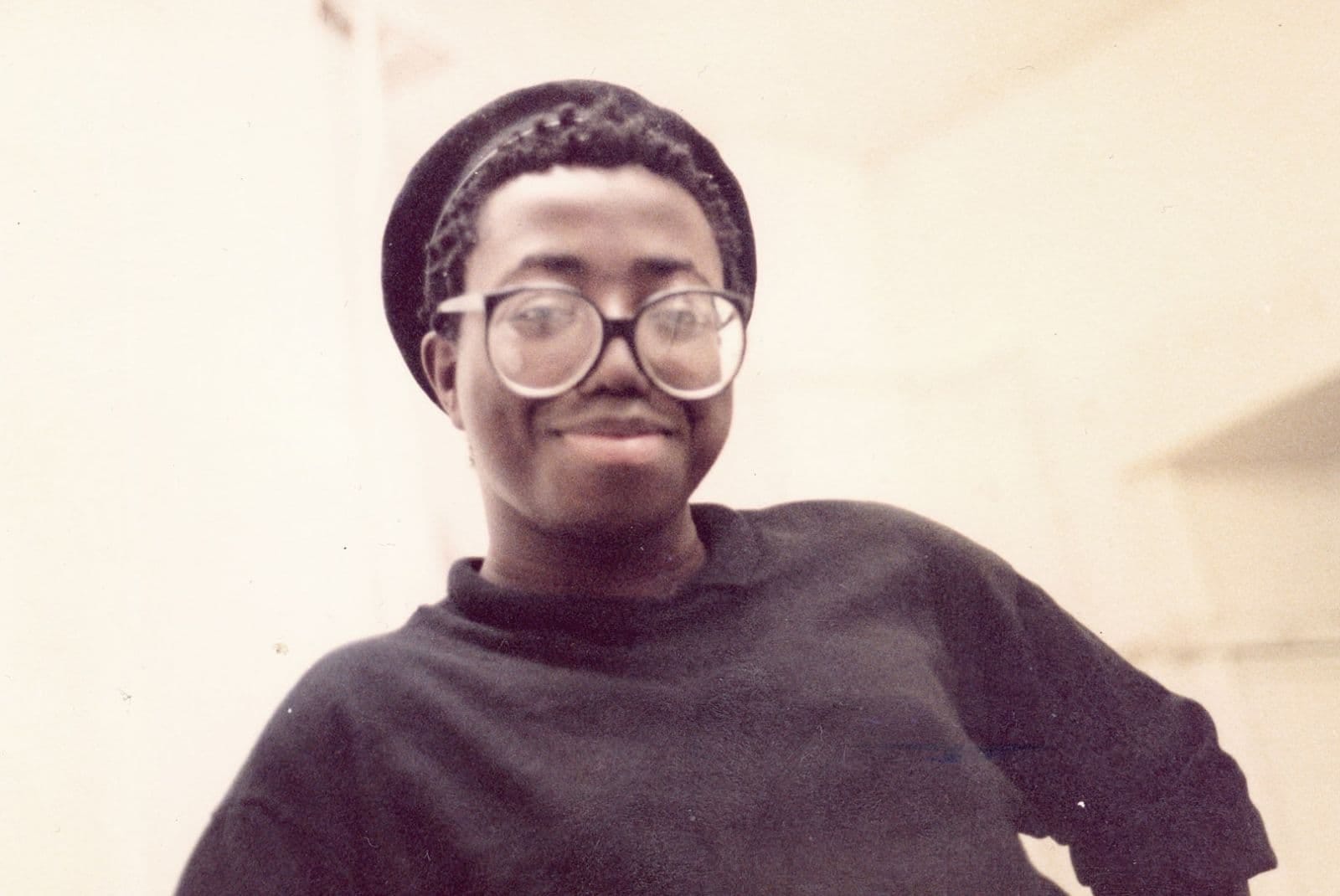
Donald Rodney (1961 -1998) died at only 36 years-old, just as his star was rising. A leading figure in the BLK Arts group of the 1980s — an association of young Black artists who took inspiration from the Black Arts movement as a tool of political expression and change — Rodney’s sickle-cell anaemia left him bedridden and hospitalised for much of his later life.
Rodney grew up on the outskirts of Birmingham, and eventually came to study Fine Art at Trent Polytechnic in Nottingham, where he first met Keith Piper — a founding member of the BLK Arts group. Piper inspired him to create work that spoke to his experience as a Black man, and as his practice grew he would go on to appropriate images from mass media and popular culture as a means of exploring not just issues of racial identity and racism, but disability as well.
Sickle cell attacked Rodney’s bones, and one of his primary medias was X-Rays, which he acquired cheaply as a waste product of the hospital system. These X-Rays became supporting pillars for many of the paintings exhibited in his successful 1989 Chisendale show.
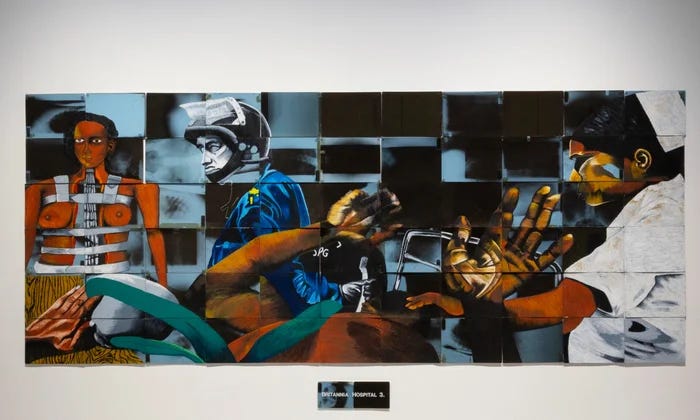
In The Guardian’s review of a recent post-humous exhibition of his work, the writer Hettie Judah describes one of his most famous pieces from Chisendale, titled Britannia Hospital:
“A sequence of figures occupies the 4.5m length of Britannia hospital. To the left is a figure based on Frida Kahlo’s Broken Column (far from an obvious reference at the time). It’s clear how Kahlo’s image of a damaged and painful body would have appealed to Rodney, but rather than taking it as a personal emblem, he has given her the face of Cherry Groce, who was shot in the shoulder by the Metropolitan police in 1985, leaving her paralysed from the chest down.
“Beside her stands an empty-eyed member of the Met’s Special Patrol Group. In the foreground a dark-skinned body on a hospital bed raises its arms imploringly toward an Asian nurse.”
For Rodney, the hospital is a stand-in for British society as a whole. While he clearly worked from a place in which physical sickness was an inescapable reality, the political allusions and media references (the title is taken from a 1982 “black comedy” film by Lindsay Anderson), show us that the true sickness at the heart of the painting is primarily a racist one.
But that isn’t to say that Rodney’s work never spoke to disability more explicitly, either.
In the piece My Mother, My Father, My Sister, My Brother, Rodney constructed a miniature sculpture of a house made entirely from dried pieces of his skin, held together with dressmaker’s pins. The skin was removed in a sheet from a collapsed abscess on his own body after he underwent a hip replacement operation, dried between the pages of a book, and then built.
Keep reading with a 7-day free trial
Subscribe to Laura Elliott to keep reading this post and get 7 days of free access to the full post archives.